 中国水利水电科学研究院
中国水利水电科学研究院
中国水利水电科学研究院
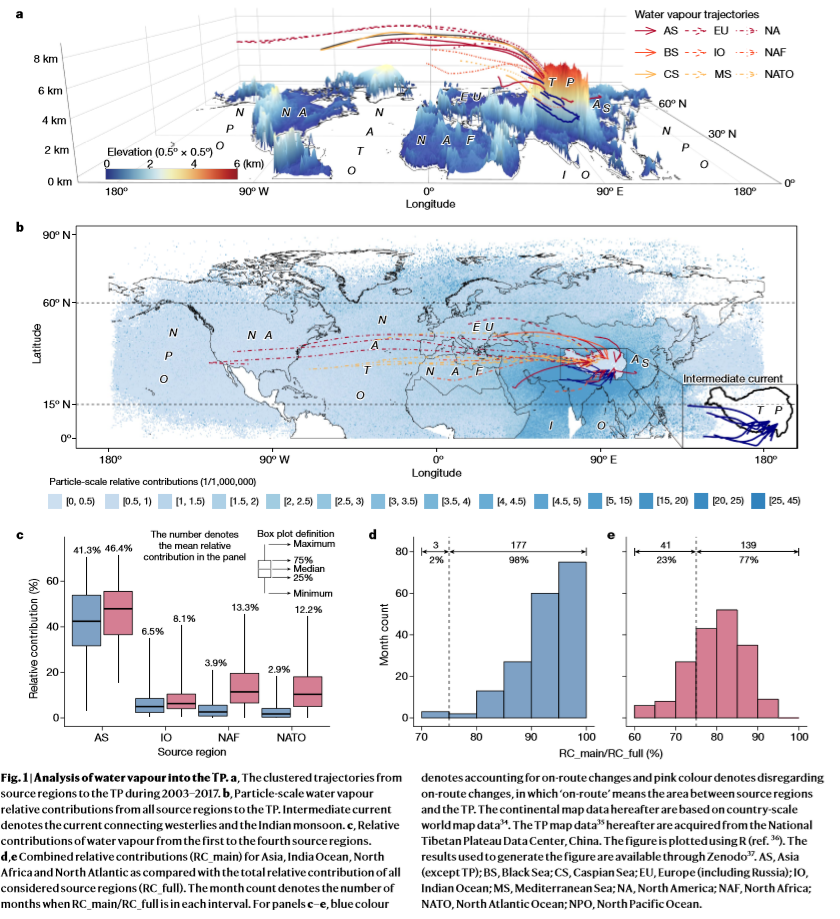
青藏高原(TP)周围的亚洲高山(HMA)——被称为亚洲水塔——的水资源可持续性引发了广泛关注,因为HMA保护数百万人免受水压力的影响1,2。然而,人们对TP上陆地蓄水(TWS)中观察到的不均匀趋势背后的机制仍知之甚少。在这里,我们使用拉格朗日粒子散射模型和卫星观测,将大约1 2003-2016年,TP南部的月TWS下降到西风带的Gt导致北大西洋东南部的降水量减去蒸发量(PME)不足。我们进一步表明,HMA阻断了PME缺陷向中央TP的传播,导致每月TWS增加约0.5 此外,变暖导致的雪和冰川融化以及干旱导致的HMA TWS消耗削弱了HMA山脉的阻塞,导致自2009年以来TP的TWS赤字持续向北扩大。2020-2021年期间卫星观测验证的两种排放情景下的未来预测表明,到21世纪末,多达84%(情景SSP245)和97%(情景SSP585)的TP可能会受到TWS赤字的影响。我们的研究结果表明,HMA的水系统正朝着不可持续的方向发展,这可能会加剧下游的水压力。
Water resources sustainability in High Mountain Asia (HMA) surrounding the Tibetan Plateau (TP)—known as Asia’s water tower—has triggered widespread concerns because HMA protects millions of people against water stress1,2. However, the mechanisms behind the heterogeneous trends observed in terrestrial water storage (TWS) over the TP remain poorly understood. Here we use a Lagrangian particle dispersion model and satellite observations to attribute about 1 Gt of monthly TWS decline in the southern TP during 2003–2016 to westerlies-carried deficit in precipitation minus evaporation (PME) from the southeast North Atlantic. We further show that HMA blocks the propagation of PME deficit into the central TP,causing a monthly TWS increase by about 0.5 Gt. Furthermore, warming-induced snow and glacial melt as well as drying-induced TWS depletion in HMA weaken the blocking of HMA’s mountains, causing persistent northward expansion of the TP’s TWS deficit since 2009. Future projections under two emissions scenarios verified by satellite observations during 2020–2021 indicate that, by the end of the twenty-first century, up to 84% (for scenario SSP245) and 97% (for scenario SSP585) of the TP could be afflicted by TWS deficits. Our findings indicate a trajectory towards unsustainable water systems in HMA that could exacerbate downstream water stress.
Zhang, Q., Shen, Z., Pokhrel, Y. et al. Oceanic climate changes threaten the sustainability of Asia’s water tower. Nature 615, 87–93 (2023).